UKRAINE PULSE
News, Advice and Practical Guides for Ukrainians Abroad
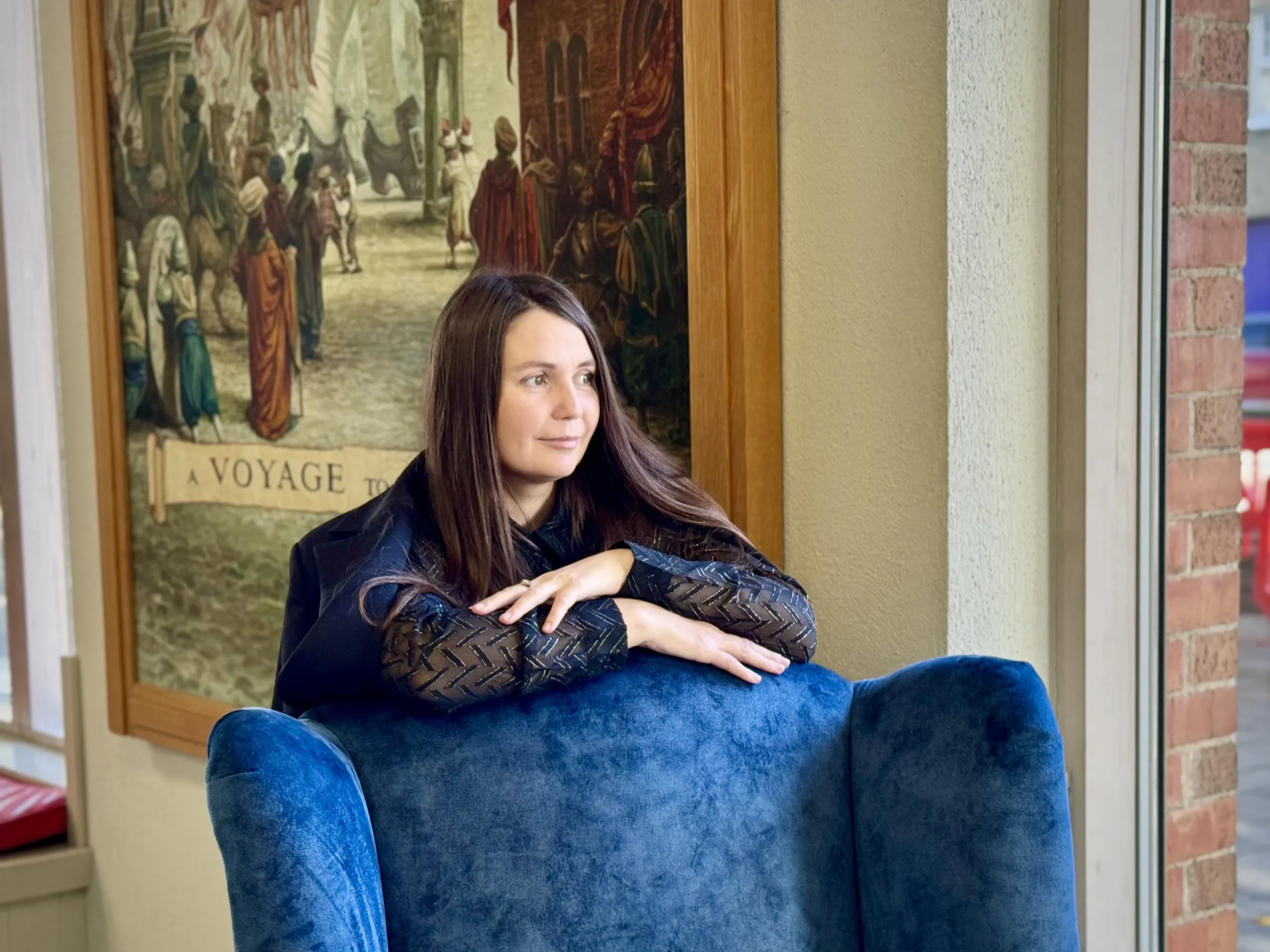
Journalism has been the work of my life since I was 5 years old. I would tear out two double sheets from a lined notebook, glue them together to create the size of a newspaper spread, and write news, articles, and even draw photos for the materials with captions showing the day and time they were taken. I was the publisher, journalist, photographer, editor, and owner of the publication. My first followers, as it’s trendy to say now — cats Lena and Katya — highly valued my work. They especially enjoyed fighting for the right to be the first to tear and chew my newspapers. But I didn’t care about any of that. I just knew — I would be a journalist.

I imagined every detail of my future. How I would get up at three in the morning and go somewhere on a night assignment (very romantic). And by sunrise, I would be live with a microphone conducting interviews. I imagined how people would just be opening their eyes to milk the cows, and I’d already be live interrogating someone.
For some reason, I absolutely had to be wearing black leather pants, with black hair slightly longer than my shoulders and definitely with a perm.
At that time, it was the height of fashion — women would burn their hair getting perms for those tiny curls.
Quite contrasting fantasies, you might say. Me with curls on the other side of the planet doing reports for those who get up to milk cows. But you have to understand the context of the time I lived in. 1991, I’m 5 years old, living in a village of 50 houses, where people’s activities revolved around turkeys, pigs, chickens and their eggs, plus cows and cream separators — those who remember know what that is. And hair perms.
My dream of being a journalist didn’t fit at all into the local landscape. Honestly, I remember when the 1+1 channel appeared on television. It was more than a flight to space for me. That was 1995. I was already 9 years old. And I’d been drawing newspapers since I was 5 (that’s what I clearly remember). How it got into my head and from where — I have no idea. Where I picked up those dreams — only God knows. But I clearly remember how funny it was when, among the collective farm workers, I announced that I would be a journalist.
Eventually, the cow population began to decline, cowsheds were closed, even their buildings began to crumble. So I realized — I definitely couldn’t become a shepherd anymore, which meant I had to become a journalist.

After finishing school, children and their parents planned their futures realistically. Either a profession as an accountant or seamstress at a vocational school 60 kilometers from home. Or the wealthy option: university in Odesa with professions in the field of agronomy or food industry.
My now-deceased tractor teacher said: “Inna, think about it! Being a tractor operator is a very prestigious profession for a woman. And they even get benefits from the state!” Yes, yes, I had a separate subject in school — tractor. I still remember all those transmissions, differentials, brake systems. And the exam, which was mandatory. My teacher genuinely wished me well and wanted to direct me toward the path of a tractor operator. Only one problem — I was short, so my legs didn’t reach the pedals.
Well, there was no choice left, and I stood my ground — journalism. My super-smart friend, who in those pre-internet years had taught himself English from books, hearing my idea, twirled his finger at his temple.
“Have you seen the journalism department? Glass walls floor to ceiling. Have you seen the parking lot by the department? Students arrive in Hummers. Even I, so smart, didn’t dream of getting in there — I chose the history department. Where do you think you’re going?”
I remember in childhood they told village children — study well, because if you do poorly, you’ll be twisting cows’ tails all your life. I looked around, and there were no more collective farms, you couldn’t twist cows’ tails as a backup plan anymore. So without options — journalism remained.

I didn’t throw myself into fears (what if I can’t) or stereotypical thinking (look at what cars they drive to the department). I didn’t think about the result. I just prepared for entrance exams. Ukrainian language and literature, essay writing, and I don’t remember what else. I submitted documents for the correspondence department, because I had to work in parallel and rent housing. On exam day, it was hard to push through to the classroom. I was surprised there were so many people wanting to work as journalists. The exam itself has completely faded from memory. But I remember the result — I got in.
Then, if memory serves, six years of study, working at night, studying during the day. Ah, exactly. I entered the correspondence department but received permission from the dean’s office to attend lectures with the full-time students. So I studied in two groups at once.
In parallel, over two years, quite by accident, my career in the service sector was built. I just worked there part-time alongside my studies. Started with a career as a bagger. Those who remember, there were such royal times when you bought groceries at the supermarket, and a separately hired person put everything feng shui into a bag. That person was me. And then something happened. They started promoting me. To cashier, then senior cashier, administrator, and suddenly I realized they’d soon offer me store manager. And here’s the problem. Because the salary there was good. Which means the money would pull me in, and then quitting and starting from zero, in cold and hunger building a career in journalism would be almost impossible. So in my third year of university, I decided to quit. The store director shouted after me: “Journalists are always hungry, there are no good salaries there.” And he was right, by the way.

My first salary in journalism was 600-700 hryvnias per month. And this lasted for at least two years. It was a newspaper, then television was added, then some freelancing, then projects. The dream almost came true. I got up at three in the morning, went on assignments, but didn’t go live at five in the morning. Everything was much more romantic: a report about human remains floating in the estuary because they’d been washed out from the cemetery due to a burst in the old sewage system. And in summer, when the heat was 40 degrees. And another problem — leather pants and perms were no longer in fashion. I had to adjust my dreams a bit.
But I loved those assignments. Those early mornings. I loved and love people, listening to their stories, telling their joys and sorrows. And then lawsuits were added. Because I grew up and started telling adult stories about embezzlement of budget funds. Actually, that’s why those human remains were floating in the estuary. Because according to documents, the water supply and sewage had just been fixed. But the fish in the lake floating belly-up from poisoning somehow disagreed. And I disagreed with many things. Which is why not only lawsuits arrived, but also threats, notes, calls, and even my office door was kicked in.
The topic of burial of toxic chemicals from Soviet times in the Odesa region became my second self for several years. I went to bed with it and woke up with it. Investigations, intrigues, deaths, threats, information leaks from hidden sources — but I believed our authorities could be pushed. That they would pay attention to the cancer mortality rate in that region, which exceeded normal indicators.
I received my press card in 2007. And since then, countless topics, assignments, acquaintances, excitement and tears that I’ve experienced. I know for sure that I didn’t betray my dream and that the dream wasn’t deceptive.

I arrived in Ireland in 2022. I didn’t plan to work as a journalist here. I didn’t know English at the time, and journalism in Europe itself differs greatly from ours. I was looking for work anywhere. Stores, coffee shops, washing dishes, it didn’t matter. But they wouldn’t hire me. I understand why. Hiring a mother of children who has no one to look after the children is a headache. So I had to look for other earning options.
The second factor that brought me to journalism here was my own experience. I was socializing, learning the language, knew absolutely nothing, didn’t understand the culture, just like everyone else. But I love to investigate and research. And listen to people’s stories that end up on my paper. People wrote to me — tell us how to get a driver’s license, how to validate a diploma, how to enroll a child in kindergarten… So the idea of returning to journalism arose from people’s demand.
But how to organize it all? Only through registering as a sole proprietor. Which means raised stakes again, life at high speed, because I had to learn everything at once: legislation, taxes, courses, language, not forget about my own children, and learn to live between relocations. And so Ukraine Pulse was born — the first online media created specifically for Ukrainians building new lives abroad, escaping the war.
We tell the stories of those who, having lost everything, found the strength within themselves to start from scratch in another country. Unique interviews with successful Ukrainians around the world inspire and show that nothing is impossible. We share practical advice: how to open a business abroad, what legislative requirements need to be considered, how to adapt to new conditions.

Oh, well, it’s when you didn’t have enough problems and decided to add more. When you already didn’t have enough funds, and here you take on the obligation to share them with other people (insert laughing emoji here).
When instead of an eight-hour workday you work 24/7, but now it’s called a “flexible schedule” and “being your own boss.”
It’s when you’re simultaneously an accountant, marketer, courier, manager, and cleaner, because you need to “save on salaries.”
It’s a state when you check your account balance more often than social media, and rejoice at every transfer as if you won the lottery.
Ukraine Pulse is powered by its readers. Support us with a subscription or a one-time donation, and we’ll be able to publish more practical guides and stories of Ukrainians around the world.
In reality, you can’t stop and you keep going. Because entrepreneurship is also freedom, drive, and the feeling that your success depends only on you. And your failure — too. It’s the moment when at three in the morning you come up with a brilliant idea, it’s when you say “Never again!”, but a month later you launch a new project.
Starting something new in a foreign country is always scary. Especially when you don’t know the language, don’t have connections, and around you — only the unknown. But if you’ve already survived war, evacuation, the loss of everything familiar — then you already have that courage needed to start.
Ukraine Pulse is proof that even in the most difficult circumstances, you can build. Not perfectly, not without mistakes, but build. And if this story inspires at least one person to improve their life — then it was all worthwhile.
Inna Yakimenko